














Related Articles
Stay Up To Date
Something has gone wrong, check that all fields have been filled in correctly. If you have adblock, disable it.
The form was sent successfully
Recent volatility across AI infrastructure contrasts sharply with the evidence emerging from earnings season and model development. In our view, the sell-off has been driven primarily by technical pressures, crowded positioning, and renewed debate over the return on AI investment rather than a deterioration in underlying demand. Recent business results instead point to accelerating cloud growth, improving economics, and persistent capacity constraints. The widening gap between price action and our fundamental assessment reinforces our conviction in the long-term opportunity across the businesses providing the enabling infrastructure for AI.
The Correction
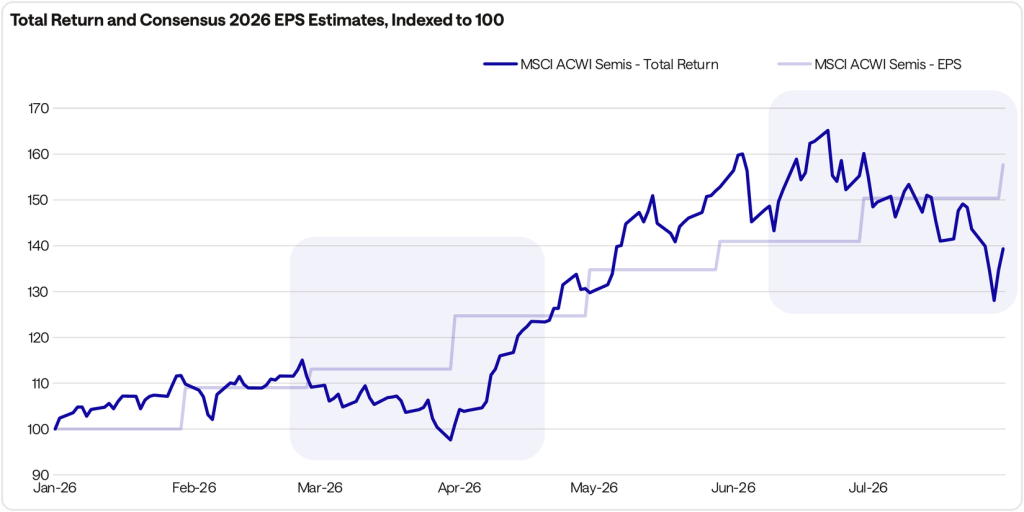
The correction followed an extraordinary advance. The PHLX Semiconductor Index gained approximately 80 percent in the second quarter, its strongest quarterly return since the index was created in 1993. Positive earnings revisions supported much of that performance, but ownership and momentum also reached historically elevated levels. The subsequent reversal was severe: by late July, the index had fallen more than 20 percent from its June peak, and all 30 constituents were trading below their 50-day moving averages. This setup left the group vulnerable to even modest shifts in the narrative and may have amplified indiscriminate selling.
Several developments provided a catalyst for the unwind. Meta Platforms’ discussion of potentially renting excess computing capacity, the release of Moonshot AI’s lower-cost, open-source Kimi K3 model, and the initial public offering of Chinese memory provider ChangXin Memory Technologies (CXMT) intensified concerns that AI compute could become more abundant and less profitable. Combined with renewed scrutiny of hyperscaler capital spending, these developments raised questions about the durability of AI infrastructure demand. The proliferation of leveraged products tied to the AI buildout likely magnified the move as weakening momentum triggered forced selling. We believe these developments are important to monitor, but the market reaction has been disproportionate to their fundamental implications.
AI Infrastructure Share Prices Have Disconnected from Fundamentals
In July semiconductor-related shares fell, despite increasing consensus earnings estimates. We observed a similar dynamic in March.
Fundamentals Remain Supportive
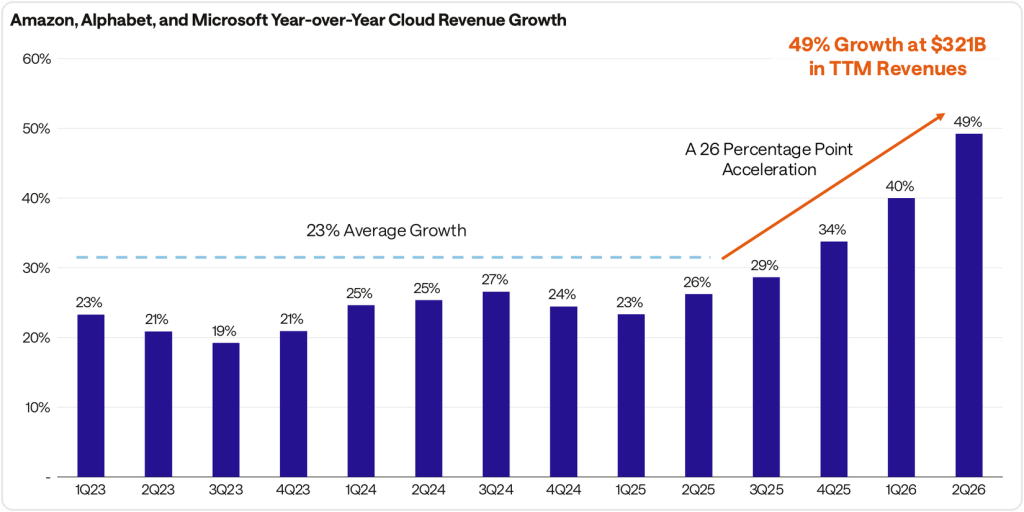
Second-quarter results from the cloud hyperscalers reinforce that demand remains strong and the economics of AI infrastructure are improving. Revenue growth across the cloud businesses of Alphabet, Microsoft, and Amazon accelerated at stable or expanding margins. Google Cloud, for example, grew revenue 82 percent year over year while expanding EBIT margins by 300 basis points quarter over quarter. These results suggest new capacity is being absorbed quickly and that AI workloads are supporting, rather than undermining, cloud profitability.
The strength of hyperscalers’ custom-silicon businesses provides additional evidence that AI infrastructure spending is generating attractive returns. Amazon disclosed that its custom-chip business has reached a $25 billion annualized revenue run rate, while Trainium, its internally designed AI accelerator, now supports more than half of the usage on Amazon Bedrock, its platform for deploying generative AI models, and serves as Anthropic’s primary inference chip. By directing growing token demand toward lower-cost proprietary silicon, AWS has sustained high utilization and expanded margins to 39 percent. Alphabet is seeing a similar opportunity with its tensor processing units, which contributed to a strong quarter. These results may indicate that custom silicon is becoming both a cost advantage and a meaningful source of revenue and returns.
At the same time, compute capacity remains constrained. Alphabet raised its 2026 capital spending outlook by $15 billion because it could accelerate the delivery of capacity, repeatedly described the business as supply constrained, and entered a temporary agreement to access SpaceX compute at a premium. Amazon similarly noted that meaningful capacity is already reserved through 2028 and emphasized that it brings capacity online only when it has strong visibility into customer demand. In our view, these anecdotes indicate hyperscaler spending is being supported by visible demand, growing backlogs, and attractive incremental economics rather than speculative expansion.
We see similar signals across AI infrastructure. Taiwan Semiconductor’s 78 percent earnings growth drove further upward revisions to 2027 and 2028 estimates, reinforcing the strength of leading-edge semiconductor demand. Meanwhile, visibility has improved for memory providers. Micron Technology has signed 16 strategic customer agreements, most extending through 2030 as take-or-pay contracts with binding volume commitments, while SK hynix has secured five-year agreements with 10 customers. These commitments improve visibility into demand, pricing, and production planning, while phased capacity additions reduce the risk of the speculative oversupply that characterized prior semiconductor cycles.
AI Usage Is Contributing to Accelerating Cloud Revenue Growth
Combined year-over-year cloud revenue growth for Amazon, Alphabet, and Microsoft jumped to 49 percent last quarter as new AI capacity is absorbed as fast as it's added.
Evaluating Chinese Competition
The progress of newer AI models also supports continued infrastructure demand. Lower-cost Chinese open-source models, including Moonshot AI’s Kimi K3, have intensified concerns that frontier capabilities may require less capital. Yet Kimi K3 reached competitive performance by scaling to 2.8 trillion parameters, illustrating that lower cost does not necessarily mean less compute. Cheaper and more accessible models should broaden adoption, while private deployments and agentic workloads require substantial memory, networking, and inference capacity. Efficiency gains reduce the cost of a unit of intelligence, but they can also stimulate far greater consumption. The relevant question is therefore not whether models become cheaper, but whether falling costs expand usage faster than efficiency reduces the compute required for each task. We believe the evidence increasingly points in that direction.
Meanwhile, structural constraints continue to support pricing across the memory market. The initial public offering of Chinese memory producer CXMT has raised concerns that faster capacity growth could eventually weaken the supply-demand imbalance supporting earnings revisions for memory providers. CXMT is a genuine competitor in dynamic random-access memory (DRAM) that we expect to grow substantially faster than the broader industry, contributing to aggregate memory supply growth in the low-20 percent range over the next several years. However, we continue to expect demand growth to exceed 30 percent, supported by AI infrastructure and rising memory content across end markets. Moreover, much of CXMT’s incremental output is likely to be absorbed domestically. As a result, additional Chinese production may largely substitute for imported memory within China rather than materially loosen the global market.
More importantly, CXMT does not yet address the advanced-memory bottleneck at the center of our thesis. High-bandwidth memory (HBM) consumes roughly three to four times the wafer capacity per bit of standard DRAM and is more complex to manufacture and lower yielding, giving producers a strong incentive to prioritize HBM while constraining the capacity available for commodity products. That intensity continues to rise as the industry advances, meaning nominal wafer additions translate into much less effective bit supply than in prior cycles. CXMT remains an estimated two to three years behind the industry leaders in HBM, so additional commodity DRAM capacity does little to relieve the constraint currently setting prices.
New supply is also slower to arrive. Earlier expansions were largely brownfield projects that could add capacity relatively quickly, while meeting today’s demand increasingly requires greenfield fabs that take two to three years to build and ramp, with limited meaningful relief before 2028. At the same time, a once-fragmented industry that repeatedly overshot demand has consolidated around Samsung Electronics, SK hynix, and Micron Technology, which are allocating capacity toward the highest-margin opportunities and increasingly securing demand through long-term agreements. These conditions suggest CXMT may become a more meaningful source of supply later in the decade, but we view that as a potential later-cycle risk rather than a challenge to its near- and medium-term foundation.
The Opportunity
As fundamental investors, our edge lies in developing a deep understanding of industries and businesses that allows us to distinguish short-term noise from changes in long-term earnings power. Periods of volatility can test conviction, but they can also create opportunity when price action becomes disconnected from underlying fundamentals. Our research process is designed to identify those moments and maintain conviction where the evidence supports it.
The recent retracement across AI infrastructure has driven valuations to more attractive levels and embedded a more skeptical view of the cycle. In our assessment, that skepticism conflicts with the evidence from cloud growth, backlogs, margins, utilization, customer commitments, and persistent capacity constraints. We recognize that the pace of investment and rapid evolution of the technology will continue to create volatility. However, the divergence between sentiment and technical conditions on one hand, and our assessment of the fundamental outlook on the other, may create an opportunity. It also sustains our conviction that select providers of compute, memory, networking, and power infrastructure remain positioned to benefit from a durable and expanding AI investment cycle.
Disclosures:
The views expressed are the opinion of Sands Capital and are not intended as a forecast, a guarantee of future results, investment recommendations or an offer to buy or sell any securities. The views expressed and all estimates and figures presented were current as of the date indicated and are subject to change. This material may contain forward-looking statements, which are subject to uncertainty and contingencies outside of Sands Capital’s control. No reliance should be placed on these forward-looking statements. Past performance is not indicative of future results. Differences in account size, timing of transactions and market conditions prevailing at the time of investment may lead to different results, and clients may lose money. Forward earnings and revenue projections are not predictors of stock price or investment performance, and do not represent past performance. Characteristics, sector (and regional, country, and industry where applicable) exposure and holdings information are subject to change and should not be considered as recommendations.
The specific securities identified and described do not represent all of the securities purchased, sold, or recommended for advisory clients. There is no assurance that any securities discussed will remain in the portfolio or that securities sold have not been repurchased. References to specific issuers or securities are provided for illustrative purposes only and are not intended as recommendations to purchase or sell such securities. It should not be assumed that any investment in the securities of the issuers referenced was or will be profitable. There is no guarantee that Sands Capital will meet its stated goals. All investments are subject to market risk, including the possible loss of principal. Recent tariff announcements may add to this risk, creating additional economic uncertainty and potentially affecting the value of certain investments. Tariffs can impact various sectors differently, leading to changes in market dynamics and investment performance. Investments in companies utilizing artificial intelligence (AI) involve additional risks. AI technologies are rapidly evolving and may be subject to regulatory uncertainty, ethical concerns, and operational challenges. There is no assurance that AI-driven strategies will be successful, and companies may face risks related to data quality, model accuracy, cybersecurity, and unintended outcomes, which could adversely affect business results and investment performance.
References to the “firm”, “we” or “our” are references to Sands Capital. Sands Capital refers to the combination of Sands Capital Management, LLC, Sands Capital Alternatives, LLC and Sands Capital Horizons, LLC. All three firms are registered investment advisers with the United States Securities and Exchange Commission in accordance with the Investment Advisers Act of 1940. The three registered investment advisers share certain personnel, office space, and other resources.
This communication is for informational purposes only and does not constitute an offer, invitation, or recommendation to buy, sell, subscribe for, or issue any securities. The material is based on information that we consider correct, and any estimates, opinions, conclusions, or recommendations contained in this communication are reasonably held or made at the time of compilation. However, no warranty is made as to the accuracy or reliability of any estimates, opinions, conclusions, or recommendations. It should not be construed as investment, legal, or tax advice and may not be reproduced or distributed to any person.