











Contributors

Related Articles
Stay Up To Date
Something has gone wrong, check that all fields have been filled in correctly. If you have adblock, disable it.
The form was sent successfully
Modern slavery, including forced labor and human trafficking, continues to present significant and often hidden risks across global supply chains. For long-term investors, these risks are no longer peripheral—they can affect corporate strategy, regulatory exposure, and operational resilience. Through focused research and active ownership, we strive to spot red flags and help reduce issues within our portfolio businesses in an effort to secure long-term value for our clients.1
Key Points
- Modern slavery is widespread across a diverse range of geographies, industries, and supply chains, often emerging in unexpected sectors with risks manifesting in both direct and indirect forms.
- Exploitative labor practices introduce substantial operational, reputational, legal, and regulatory risks that can handicap companies’ long-term growth and success.
- As active long-term investors, we are well positioned to identify and help reduce these risks through business-focused research and proactive engagement with our portfolio companies as part of our efforts to support long-term value creation for our clients.
In April 2013, the tragic collapse of Bangladesh’s Rana Plaza complex claimed the lives of more than 1,000 garment workers. The lethal consequences of unsafe working conditions drew global attention, including consumer boycotts of implicated apparel brands.2 Years later, allegations of forced labor at factories in Boohoo’s U.K. supply chain led to a sharp decline in its share price and reputational standing as retailers pulled its products.3 These incidents illustrate the human and financial consequences of labor exploitation. Although unsafe conditions and low wages do not, on their own, establish modern slavery, they can signal weaknesses in labor oversight that warrant closer scrutiny.
While apparel has drawn particular attention, modern slavery risks and broader labor concerns extend to the raw materials and services that support many other industries. Today, we see a wide range of modern slavery risks—from the extraction of raw materials to invisible forms of digital labor—across sectors. One prominent challenge for many of our portfolio businesses is the use of conflict minerals, such as tin, tantalum, tungsten, and gold (3TG), as well as cobalt. These materials are critical to the production of semiconductors, electronics, and batteries, but they are often sourced from high-risk regions where forced labor and weak governance are common. Elsewhere, in the race to employ artificial intelligence, companies have been criticized for relying on “ghost workers”—low-paid, often hidden contract workers performing essential but invisible tasks, such as labeling data and moderating content.4 Whether embedded in physical supply chains or hidden behind digital services, these labor concerns can be difficult for companies and investors to detect and assess.
Labor exploitation, while a serious ethical issue, is also a material business risk that can erode consumer trust, impair a company’s reputation, and destroy shareholder value.
What Is Modern Slavery?
Modern slavery refers to the exploitation of people through coercion, force, or deception, often in the form of forced labor, human trafficking, debt bondage, and involuntary servitude. According to Walk Free’s 2023 Global Slavery Index, nearly 50 million people are enslaved across the globe, with 28 million people trapped in forced labor. Over 12 million of these total victims are children.6
Exhibit 1
UNDERSTANDING THE COMPLEXITIES OF MODERN SLAVERY
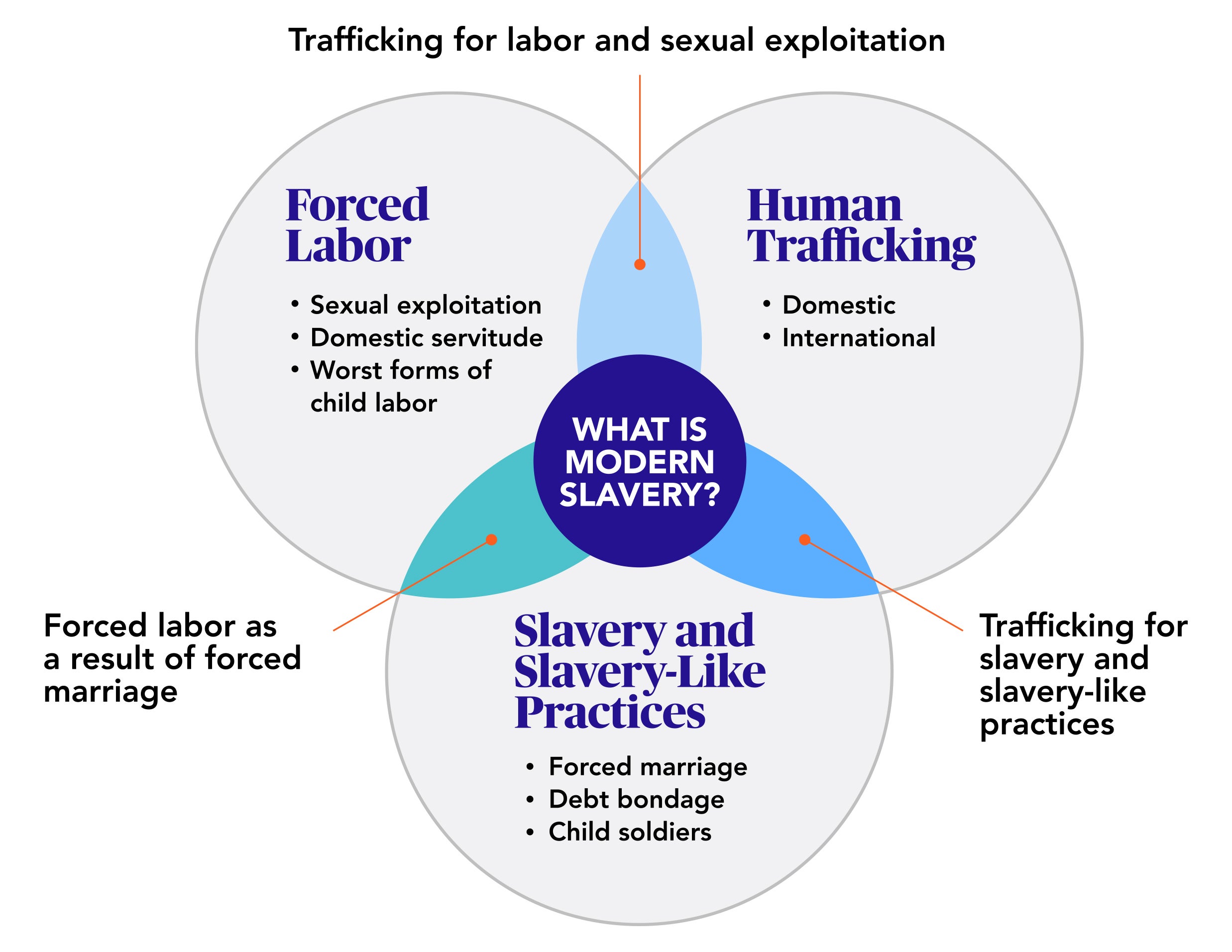
The rise in modern slavery is fueled by a complex set of global dynamics. Globalization, widening inequality, climate-related displacement, political instability, and the lingering effects of the pandemic have intensified worker vulnerability and obscured certain abuses in supply chains. At the same time, enhanced data-collection efforts and increased scrutiny may have led to more cases being identified and reported.
In response, efforts to combat modern slavery are accelerating. Governments are introducing stronger due diligence legislation while nongovernmental and global organizations are spotlighting high-risk sectors and geographies through advocacy, investigations, and enhanced data collection. Civil society, media, and consumers are raising expectations for corporate accountability and transparency. Yet efforts remain fragmented and inconsistent, leaving a gap in which investors have a critical role to play.
The Risks to Long-Term Growth
Higher cost of capital and stymied growth: Companies accused of exposure to modern slavery could face increased scrutiny in their efforts to pursue additional growth opportunities and market presence. Shein, a China-based fast-fashion retailer, is just one example. After abandoning planned initial public offerings in New York and London amid political and regulatory scrutiny, including concerns over alleged links to Uyghur forced labor in its supply chain, Shein shifted its listing plans to Hong Kong.7,8
Investors are also integrating human rights considerations into their risk assessments, prioritizing companies with a demonstrated commitment to responsible business practices while avoiding those exposed to forced labor. Declines in share price and diminished investor confidence can limit access to capital. Norges Bank Investment Management, which oversees Norway’s $2.2 trillion sovereign wealth fund, reported 19 risk-based divestments related to human rights in 2025, illustrating how these concerns can inform investment decisions.9
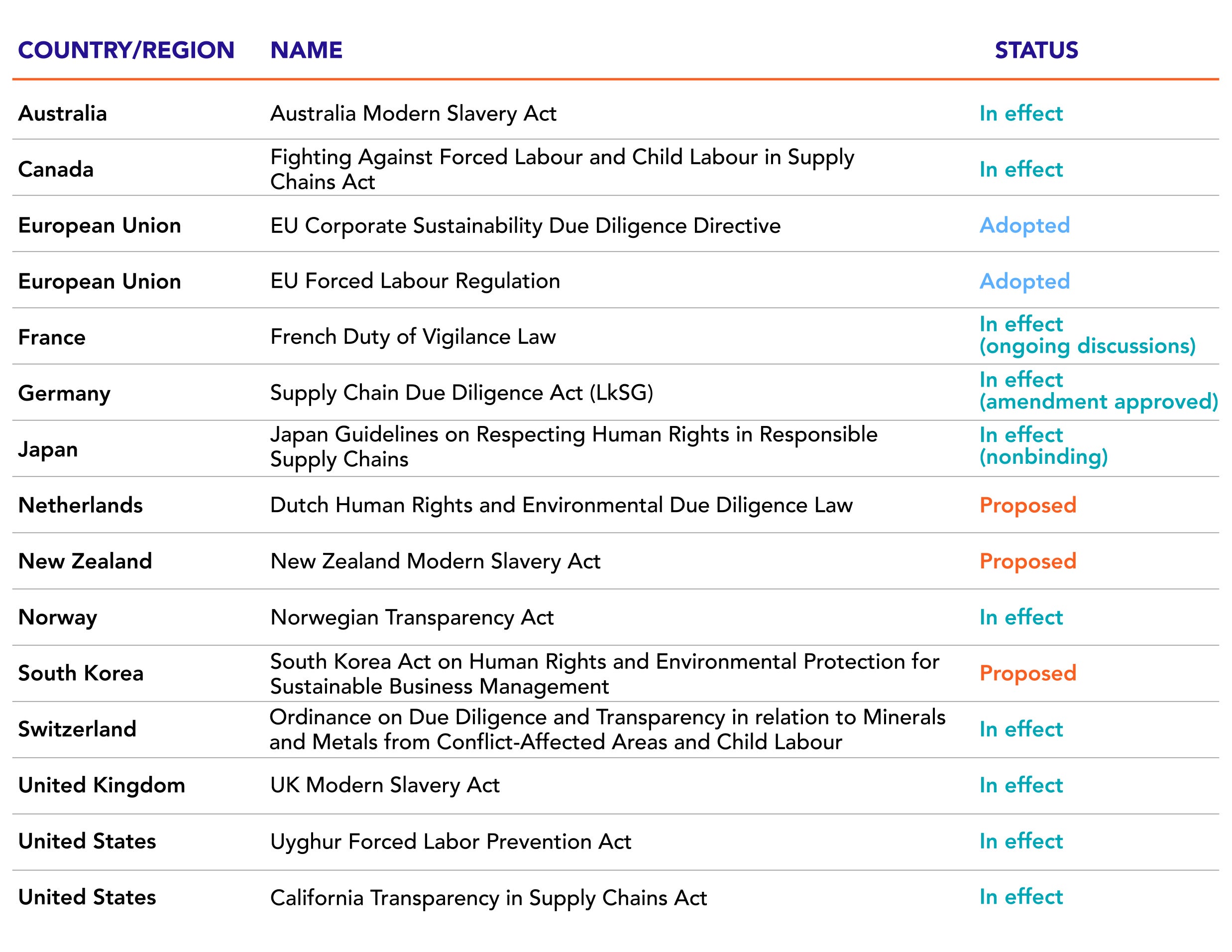
Regulatory risks and compliance pressures: Companies face an evolving mix of labor laws, supply chain disclosure requirements, and due diligence obligations. Differences in their scope and implementation across markets add complexity to compliance and sourcing decisions. Failure to comply can result in fines, legal sanctions, import bans, and restricted market access. Broader trade policy is also becoming part of this response: in 2026, the United States imposed additional tariffs on goods from 60 economies based on findings that they had not adequately prohibited imports made with forced labor or enforced existing prohibitions.10
Exhibit 2
Selected Modern Slavery Laws, Regulations, and Proposals
Operational disruptions and supply chain risks: For many companies, incidents of modern slavery can mean costly supply chain diligence and restructuring, supplier renegotiations, and logistical challenges. Industries that rely on low-cost labor or high-risk materials are particularly exposed, as forced-labor concerns can lead to product bans, contract terminations, and production slowdowns.
Industries reliant on critical minerals—such as cobalt and 3TG metals used in electronics and electric vehicle batteries—have faced mounting scrutiny over labor conditions in their supply chains, often resulting in disruptions and increased compliance costs.
Beyond the technology sector, the United States implemented the Uyghur Forced Labor Prevention Act (UFLPA) in 2022. The law presumes that goods made wholly or partly in China’s Xinjiang region are produced with forced labor and bars their entry into the United States unless the importer can overcome that presumption.11 Companies relying on Xinjiang cotton were forced to find alternative sources, often disrupting operations. Patagonia, for example, stopped sourcing cotton from China in 2020 and restructured its supply chain.12 While Patagonia’s decision preceded the UFLPA, it illustrates the kind of operational disruption such transitions can entail. Patagonia has since adopted isotopic testing to verify the geographic origin of its cotton and ensure compliance with U.S. regulations.13
Customer backlash and reputational damage: In addition to financial and regulatory pressures, many consumers in today’s interconnected world are both more informed and more vocal about their values, demanding accountability and transparency from the companies they support. Brands linked to modern slavery scandals not only face reputational damage but also risk losing customers.14
The labor exploitation allegations involving Boohoo are a prominent example, but scrutiny has extended to food and beauty companies as well. Starbucks has faced lawsuits over allegedly using coffee from farms that employed child and forced labor15 while Estée Lauder and L’Oréal have been investigated for sourcing from farms using child labor.16
The Imperative for Active Investment Management
Understanding these risks requires company-specific research into sourcing practices, business relationships, and management oversight. Active managers with long-term, concentrated strategies can draw on their knowledge of portfolio companies and ongoing dialogue with leadership to assess these exposures and discuss how they are being addressed.
At Sands Capital, we practice active ownership through engagement and proxy voting, grounded in the deep research of our investment team. Our research analysts’ company expertise and trusted relationships with management teams position them to surface vulnerabilities, including exposure to modern slavery, and to recommend stronger oversight and more resilient business practices.
To reinforce this work, our stewardship team partners with analysts to embed modern slavery risk assessments into the investment research process and to structure informed, constructive dialogues with company leadership. As part of this effort, we have partnered with Slave-Free Alliance (SFA), whose support goes beyond training to include strengthening our due diligence frameworks, developing specialized tools, and sharing best practices to enhance our ability to identify and reduce modern slavery risks.
Assessing modern slavery risk requires looking beyond whether a company has a policy or conducts supplier audits. We seek to understand where its greatest exposures lie, how it identifies problems, and what happens when concerns emerge. Greater disclosure can support that assessment; we also look for indications that companies are putting their commitments into practice and responding meaningfully when problems are identified.
Navigating Risks Across Industries
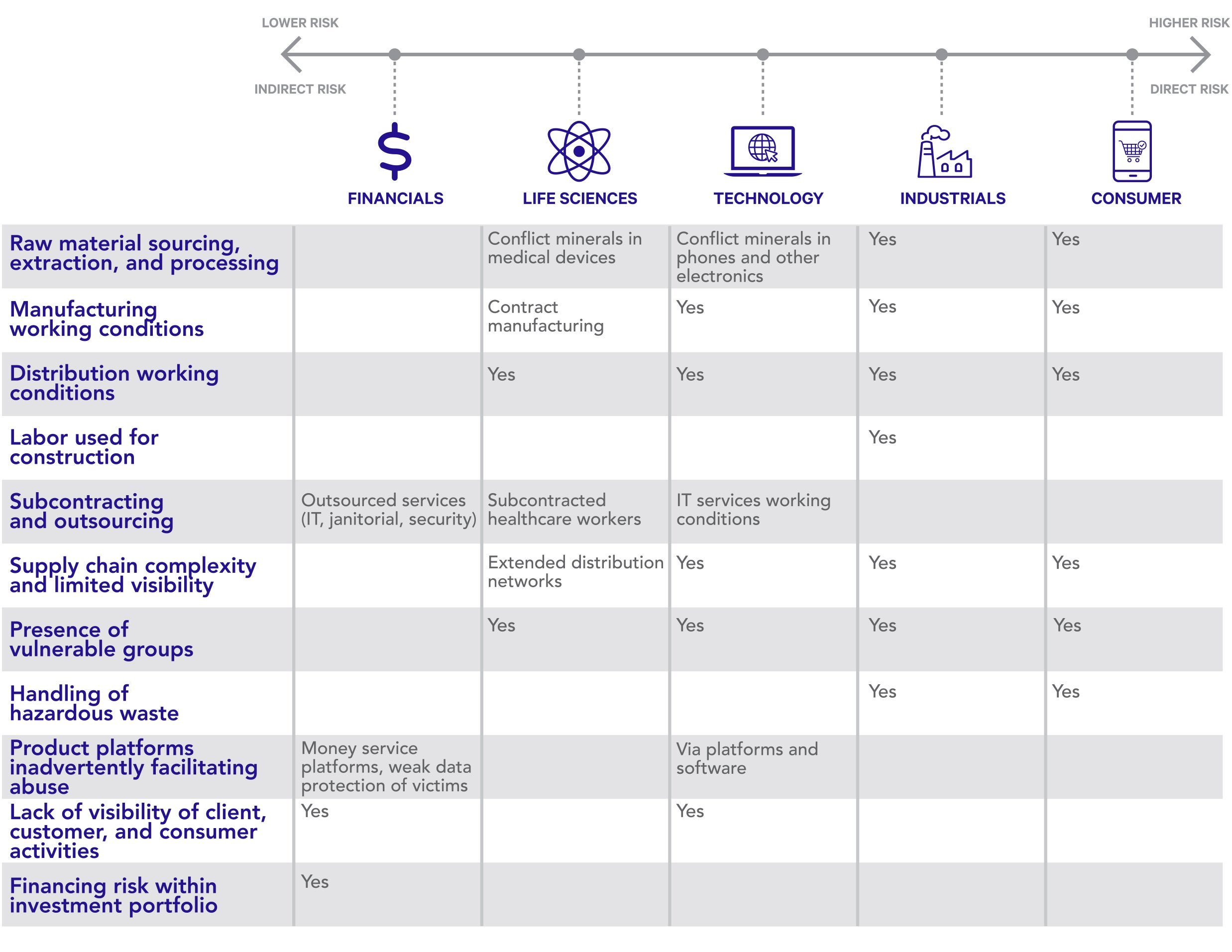
The nature of a company’s operations and business relationships shapes where modern slavery risks arise and how they can be addressed.
Direct risks are tied to a company’s core operations and sourcing activities, where supplier due diligence, regular audits, and worker-grievance mechanisms can help identify and address concerns.
Indirect risks can emerge through deeper supplier tiers, third-party service providers, product use, or financing. These exposures can be difficult to identify and assess, requiring greater traceability and oversight across business relationships. The nature and severity of risk depend on the company’s circumstances, including its sourcing locations, workforce, and controls.
Exhibit 3
UNCOVERING THE RISKS ACROSS INDUSTRIES
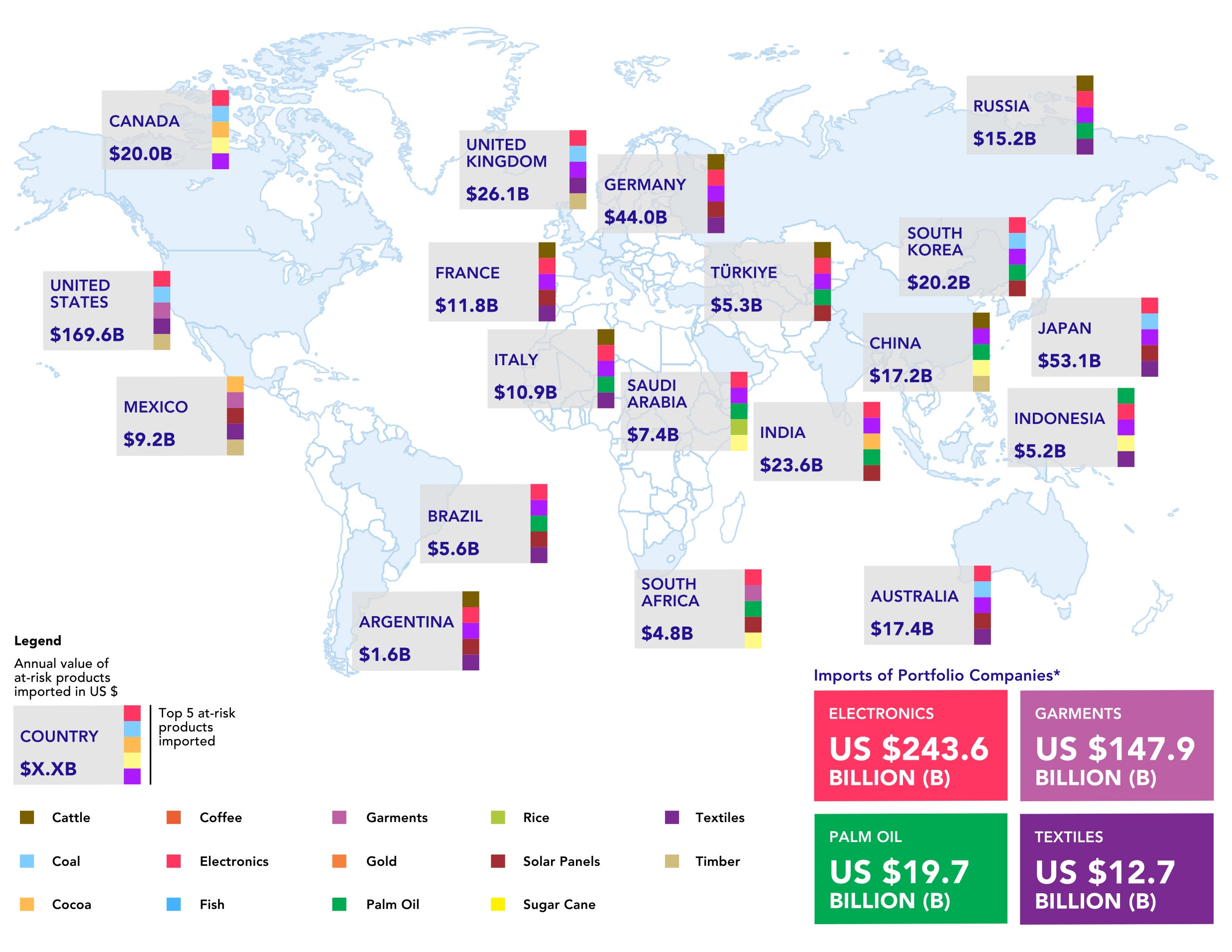
The 2023 Global Slavery Index revealed that nearly two-thirds of forced labor cases are linked to global supply chains17, with exploitation occurring across a vast range of industries and at every stage of the supply chain18. Most of this forced labor is concentrated in the early stages, such as the extraction of raw materials and production stages.
According to this data from Walk Free, the industrialized and emerging market countries of the G20 import more than $468 billion annually in goods at risk of being produced with forced labor—an inflation-adjusted increase of $61 billion since 2018. Top categories include electronics, garments, palm oil, solar panels, and textiles, many of which feature in our portfolio companies’ supply chains.19
Exhibit 4
MODERN SLAVERY RISKS SPAN GLOBAL SUPPLY CHAINS AND INDUSTRIES
Consumer and Industrials
Companies in the consumer and industrials industries may face greater and more direct modern slavery risks because they often rely on complex supply chains involving raw-material extraction, agriculture, manufacturing, and construction. Limited visibility across multiple tiers of suppliers can make it difficult to identify abusive practices, including forced overtime, restricted movement, and withheld wages, particularly among vulnerable workers such as women, children, and migrants.20
Our engagement with Anta Sports Products illustrates the challenges of assessing supply-chain oversight in a high-risk sourcing environment. Anta, China’s largest domestic sportswear company, has faced international scrutiny for its continued sourcing of cotton from the Xinjiang region, where the use of forced labor involving ethnic minorities has been widely alleged. After withdrawing from the Better Cotton Initiative (BCI) in 2021, citing political sensitivities, Anta reaffirmed its intention to continue sourcing Xinjiang cotton in line with its internal standards. This decision drew global criticism and intensified reputational risk, prompting a series of engagements on our part to understand the company’s position and encourage stronger supply chain governance.
We have engaged with Anta’s senior leadership over several years on supply-chain transparency and oversight. The company began third-party supplier audits in 2021 and reported conducting 1,047 ESG audits in 2025, with all Tier 1 and Tier 2 suppliers passing the audit and more than 88 percent receiving a “good” rating or above. During our 2025 engagement, Anta described its broader approach to supplier assessment and remediation, including a zero-tolerance policy for certain key violations and corrective action for other identified red flags within an agreed timeframe. Cotton traceability has also been a recurring focus of our engagement. We encouraged greater transparency and independent verification of cotton sourcing. Anta indicated that it was exploring external certification options for its cotton sourcing but faced difficulty identifying auditors willing to operate in Xinjiang. The difficulty of obtaining external verification in Xinjiang remains an important limitation in assessing the sourcing risks at the center of our engagement.
As part of our broader diligence approach, analysts across the investment team participate in training with SFA to strengthen their ability to spot potential red flags during site visits, such as impromptu checks of cafeterias and restrooms to evaluate general workplace conditions. This training not only helps identify risks of forced labor but also equips our team with practical tools to assess worker wellbeing and health and safety, allowing our investment team to conduct a more rigorous visit to Anta’s manufacturing site in 2023. While no immediate concerns were observed during that visit, the exercise highlighted how we apply this training to better understand on-the-ground realities.
In 2025, Anta facilitated a sustainability-themed investor tour in China that included site visits and meetings with company leadership. While we were unable to attend, we reviewed several reports from the event that pointed to continued progress on supply chain transparency and cotton traceability. Taken together, these developments and our own engagement underscore that Anta is on a journey—still catching up to global best practices on human rights while navigating the realities of geopolitics and its domestic operating environment. We will continue to advocate for increased traceability, regular third-party audits, and alignment with international labor standards. We believe the company is committed to tackling the challenges ahead.
As active investors, we believe we have a responsibility to engage with our companies to understand and discuss the potential impacts of their operations, including modern slavery.
Similar supply chain challenges exist in the food sector, where India’s sugar industry stands out as a particularly fragmented and opaque system in which exploitative labor practices are deeply entrenched and difficult to trace. Following New York Times investigative reports throughout 2024 about widespread abuses in Maharashtra, we engaged directly with Britannia, a leading Indian food products company, to understand its sourcing practices and oversight approach.
The company was open to dialogue and expressed a willingness to explore collaborative efforts to strengthen supply chain accountability. While Britannia shared that it aims to avoid sourcing from mills with known violations, it acknowledged that a small volume had been indirectly procured from a flagged mill through intermediary traders. This occurrence underscores the limitations of indirect sourcing models.
During the engagement, we emphasized the importance of identifying systemic labor risks and working more closely with high-risk suppliers. We also discussed incorporating feedback from local workers, farmers, and community organizations to better reflect on-the-ground conditions.
Following the engagement, we sent Britannia a formal letter translating our discussion into a phased roadmap for strengthening oversight of its sugar supply chain. Our recommendations ranged from near-term actions, such as independent audits and supplier mapping, to longer-term efforts, such as grievance mechanisms and broader industry collaboration. To support the conversation, we shared case studies from the Mexican sugar industry and West Africa’s cocoa sector that demonstrate how direct engagement and capacity building can improve labor conditions over time.
Britannia subsequently reported that it had strengthened its broader supplier-risk management and sustainability oversight, including more targeted engagement with higher-risk suppliers and independent on-site ESG assessments of selected suppliers.21
Technology, Life Sciences, and Financials
Technology and life sciences companies similarly navigate both direct and indirect risks.
Minerals—especially 3TG and cobalt—that are essential for manufacturing products such as semiconductors and advanced medical devices often come from regions plagued by dangerous conditions, low wages, child labor, and other human rights violations. Despite regulatory advances, such as the Dodd-Frank Act in the United States—which imposes conflict-minerals reporting requirements on certain SEC-reporting companies whose manufactured products contain necessary conflict minerals—supply-chain traceability remains extremely difficult. Companies largely rely on supplier reporting and standardized tools such as the Conflict Minerals Reporting Template (CMRT), but incomplete and unverified information can make it difficult to determine where minerals originated and whether they were responsibly sourced.
We recognize that investors, too, face limitations when it comes to addressing mineral sourcing risks. We don’t control supplier contracts or sourcing decisions, and we’re several steps removed from the people most vulnerable to abuse. Still, we use our position to evaluate how companies handle these challenges.
We began engaging more systematically on conflict minerals in 2021, after signing a Principles for Responsible Investment-led investor letter targeting the semiconductor sector. Since then, we’ve expanded our focus to include other industries in which mineral sourcing risks are high. We have organized a series of expert calls to deepen our understanding of mineral sourcing risks and developed a critical minerals due diligence resource, which we released internally in 2025.
Our engagement with Dexcom highlighted both progress and persistent challenges in responsible sourcing. Dexcom, a global leader in continuous glucose monitoring (CGM) systems, relies on electronic components that contain conflict minerals such as 3TG. In 2024, we spoke with the company to understand how it mitigates sourcing risks. During that discussion, Dexcom described several due-diligence measures: it files a Conflict Minerals Report under U.S. regulation, conducts country-of-origin inquiries to flag high-risk sourcing, and uses the CMRT through a third-party compliance platform. Notably, the company achieved a 99 percent supplier response rate and follows up directly when data is missing or inconsistent.
At the time of our 2024 discussion, the company had formed an internal working group to monitor supply chain risks but had not yet adopted new technologies to enhance traceability beyond Tier 1 and Tier 2 suppliers.
In our August 2025 follow-up, Dexcom reported joining the Responsible Business Alliance (RBA) and the Responsible Minerals Initiative (RMI). It also described a pilot of facility-level traceability checks in its recently expanded Malaysian manufacturing operations to assess whether local suppliers met its global due-diligence expectations. Dexcom indicated that, if the Malaysia pilot proved successful, it intended to extend the approach to future facilities, including its new site in Athenry, Ireland.
Beyond material sourcing, healthcare facilities also face labor risks across extended distribution networks and subcontracted services.22
Digital platforms face their own oversight challenges when relying on gig workers—freelance or contract workers who perform short-term tasks, such as food delivery or ride-hailing services. These workers often lack job security and labor protections.23
We’ve engaged with Uber Technologies, the world’s leading ride-hailing platform by market share, to understand how it addresses risks associated with underage workers using its food-delivery platform. We proactively began discussions after the media reported that food-delivery companies were using underage couriers who had accessed accounts that were rented or sold by registered couriers, exploiting a provision in U.K. employment law known as the “right to substitute.” Such reports raised concerns about potential labor exploitation and the ineffectiveness of Uber’s safeguards to prevent unauthorized account sharing, especially in alleged cases of child labor.
During our engagements, Uber explained that it requires delivery partners to verify their age and identity, with real-time selfie checks used to detect account sharing. If account sharing is detected, the account will be deactivated. In response to the nuances of U.K. law, Uber’s U.K.-specific policies mandate that any substitutes must meet strict criteria, including being at least 18 years old and having the right to work in the U.K. In a subsequent engagement, Uber explained that it is collaborating with government authorities and other industry peers, such as Deliveroo and Just Eat, to address these challenges collectively. While this remains a developing issue, we believe our engagements have helped provide valuable insights into Uber’s proactive efforts to enhance platform security and prevent unauthorized account use.
The financials sector more often contends with indirect risks. Outsourced services, such as facilities management, janitorial services, security, or information technology support, introduce vulnerabilities that can inadvertently facilitate labor exploitation. Additionally, financial services and payment platforms, including peer-to-peer (P2P) payment apps and cryptocurrencies, can be misused to move proceeds from trafficking or facilitate payments connected to exploitation, creating risks that may be difficult to detect within ordinary transaction flows.24 This risk underscores the need for enhanced data governance measures and ethical oversight across all facets of financial operations.
To better understand the risks that our fintech businesses face, we have consulted with Polaris, an anti-human trafficking organization. Through these discussions, we learned that traffickers were increasingly using P2P payment apps to facilitate illicit activities. Polaris discussed its efforts to connect with certain P2P providers, including Block’s Cash App, to establish collaborative solutions. Recognizing our positive relationship with Block, a portfolio company, we took advantage of the opportunity to connect Polaris with the right contacts at Block to exchange insights on red-flag indicators and potential solutions.
The introduction was not prompted by a specific compliance concern at Block. It illustrates another contribution investors can make: connecting companies with specialist organizations whose insights may help them identify and address emerging risks.
Looking Forward
Our work on modern slavery continues to evolve. We have developed a modern slavery due-diligence guide, a portfolio risk radar, and guidance on responsible mineral sourcing to help our investment team identify exposures and focus company discussions.
Looking ahead, we will continue to refine and apply these tools as risks evolve, focusing our research and engagement on industry- and company-specific issues that may affect the sustainable growth of our portfolio businesses and long-term investment outcomes for our clients.
1 The use of the term “active ownership” and Sands Capital’s engagement with management teams and board members does not involve any direct or indirect attempt to exert pressure to implement specific measures, change policies, or otherwise influence control over the issuer.
2 https://www.theguardian.com/commentisfree/2014/apr/24/boycotted-primark-rana-plaza-ethical-wardrobe
4 https://time.com/6247678/openai-chatgpt-kenya-workers/
5 https://www.worldbank.org/ext/en/topic/trade
6 https://www.walkfree.org/global-slavery-index/map/#mode=data
7 https://www.reuters.com/business/finance/sheins-pursuit-an-ipo-new-york-london-hong-kong-2026-07-10/
8 https://www.bbc.com/news/business-65452976
9 https://www.nbim.no/en/investments/the-funds-value/
10 https://www.federalregister.gov/documents/full_text/html/2026/07/28/2026-15181.html
11 https://www.cbp.gov/trade/forced-labor/UFLPA
12 https://fortune.com/2021/07/18/china-cotton-forced-labor-xinjiang/
14 https://www.humanrights.dk/files/media/document/Rapport_DoingWell_tilg%C3%A6ngelig.pdf
16 https://www.vogue.com/article/jasmine-farms-supplying-estee-lauder-and-loreal-linked-to-child-labour
17 https://www.walkfree.org/global-slavery-index/
18 The Global Slavery Index was designed to shed light on the extent of modern slavery and level of vulnerability to modern slavery for 160 countries, as well as the actions taken by 176 governments to address these crimes and human rights violations.
19 https://www.walkfree.org/global-slavery-index/findings/importing-risk
20 https://www.business-humanrights.org/en/from-us/knowthechain/apparel-and-footwear-benchmark/ ; https://www.business-humanrights.org/en/from-us/knowthechain/food-and-beverage-benchmark/ ; https://humantraffickingsearch.org/resource/the-sustainable-development-case-for-ending-modern-slavery/
22 https://www.gov.uk/government/publications/review-of-risk-of-modern-slavery-and-human-trafficking-in-the-nhs-supply-chain/review-of-risk-of-modern-slavery-and-human-trafficking-in-the-nhs-supply-chain ; https://acf.gov/sites/default/files/documents/otip/Forced-Labor-Risk-Supply-Chains-Considerations-Healthcare-Public-Health-508.pdf
24 https://www.fatf-gafi.org/en/publications/Fatfrecommendations/Guidance-rba-virtual-assets-2021.html
Disclosures:
The views expressed are the opinion of Sands Capital and are not intended as a forecast, a guarantee of future results, investment recommendations, or an offer to buy or sell any securities. The views expressed were current as of the date indicated and are subject to change.
This material may contain forward-looking statements, which are subject to uncertainty and contingencies outside of Sands Capital’s control. Readers should not place undue reliance upon these forward-looking statements. There is no guarantee that Sands Capital will meet its stated goals. Past performance is not indicative of future results.
All investments are subject to market risk, including the possible loss of principal. Recent tariff announcements may add to this risk, creating additional economic uncertainty and potentially affecting the value of certain investments. Tariffs can impact various sectors differently, leading to changes in market dynamics and investment performance.
As of October 5, 2026, Anta and Block were held in certain Sands Capital strategies. The companies were selected because they are among those with which we engaged about modern slavery. Companies referenced and not held in Sands Capital portfolios were used for illustrative purposes only. Britannia, Dexcom, and Uber Technologies are no longer held in Sands Capital strategies as of the publication date. However, we include them as examples based on engagements that occurred during our ownership period. These engagements remain relevant to illustrating our approach to identifying and addressing modern slavery risks. Uber was initially purchased February 2020 across different strategies, Dexcom was initially purchased in March of 2020 and Britannia was initially purchased in February of 2016. Uber was exited during the second quarter of 2025, Dexcom was exited from all strategies in the fourth quarter of 2025 and Britannia was exited in the second quarter of 2026. These companies were selected by the authors on an objective basis to reflect Sands Capital’s historical stewardship efforts. Their inclusion does not represent a current investment recommendation and should not be interpreted as indicative of future holdings or investment intent.
The specific securities identified and described do not represent all of the securities purchased, sold, or recommended for advisory clients. There is no assurance that any securities discussed will remain in the portfolio or that securities sold have not been repurchased. You should not assume that any investment is or will be profitable. A full list of public portfolio holdings, including their purchase dates, is available here.
As part of our ongoing research, Sands Capital regularly engages with the management teams and, if appropriate, board members of portfolio businesses to better understand each business’s long-term strategic vision and management of risks and opportunities, including those pertaining to environmental, social, and governance (ESG) matters. Sands Capital’s engagement with management teams and board members does not involve any direct or indirect attempt to exert pressure to implement specific measures, change policies, or otherwise influence control over the issuer. The companies illustrated represent a subset of both past and present holdings in the portfolio and were selected by the authors on an objective basis to illustrate the views expressed in the commentary. These examples are not a complete list of engagements or results and should not be interpreted as indicators of investment performance or ESG impact. These examples were selected based on the recent date of the engagements and topics discussed. The assessment of each business is based on factors that we believe are material to the long-term investment case. To receive a complete list of company engagements for the prior twelve months please contact a member of the Client Relations Team at 703-562-4000.
Sands Capital refers to the combination of Sands Capital Management, LLC, Sands Capital Alternatives, LLC and Sands Capital Horizons, LLC. All three firms are registered investment advisers with the United States Securities and Exchange Commission in accordance with the Investment Advisers Act of 1940. The three registered investment advisers share certain personnel, office space, and other resources.
Information contained herein may be based on, or derived from, information provided by third parties. The accuracy of such information has not been independently verified and cannot be guaranteed. The information in this document speaks as of the date of this document or such earlier date as set out herein or as the context may require and may be subject to updating, completion, revision, and amendment. There will be no obligation to update any of the information or correct any inaccuracies contained herein.
This communication is for informational purposes only and does not constitute an offer, invitation, or recommendation to buy, sell, subscribe for, or issue any securities. The material is based on information that we consider correct, and any estimates, opinions, conclusions, or recommendations contained in this communication are reasonably held or made at the time of compilation. However, no warranty is made as to the accuracy or reliability of any estimates, opinions, conclusions, or recommendations. It should not be construed as investment, legal, or tax advice and may not be reproduced or distributed to any person.
Risks Associated with Sands Capital’s Approach to ESG: Application of Sands Capital’s ESG process may affect the Fund’s exposure to certain issuers, sectors, regions, and countries and may affect the Fund’s performance depending on whether certain investments are in or out of favor. Sands Capital’s ESG process (including adherence to any exclusion criteria) may result in the Fund forgoing opportunities to buy certain securities when it might otherwise be advantageous to do so or selling securities for ESG reasons when it might be otherwise disadvantageous for it to do so. As a result, the Fund’s performance may at times be better or worse than the performance of funds that do not use ESG or sustainability criteria. There are significant differences in interpretations of what it means for an issuer to have positive ESG factors. The portfolio decisions Sands Capital makes may differ with other investors’ or advisers’ views. Socially responsible norms differ by country and region, and an issuer’s ESG factors or Sands Capital’s assessment of such may change over time. Sands Capital’s assessment of a company’s ESG factors could vary over time to reflect changes in a company’s performance, which could mean that a company could move from being an investment of the Fund to being divested due to ESG concerns, or conversely change from being previously considered not suitable for investment, to becoming investable. Where companies are subsequently considered not investable for ESG reasons, there may be a delay such that the Fund is temporarily invested in such companies as Sands Capital seeks to execute the transactions in an orderly manner to minimize the impact on the Fund. When conducting its ESG process (including compiling and maintaining any exclusion list), Sands Capital will rely on data obtained through voluntary or third-party reporting that may be incomplete, inaccurate, estimated, or unavailable, which could cause Sands Capital to incorrectly assess an issuer’s business practices with respect to ESG or to incorrectly include or exclude an issuer on or from any exclusion list. ESG data from data providers used by Sands Capital often lacks standardization, consistency, and transparency, and for certain issuers and guarantors, such data, including ESG ratings and scores, may not be available, complete or accurate or may be estimated.
Notice for non-US Investors.