















Related Articles
Stay Up To Date
Something has gone wrong, check that all fields have been filled in correctly. If you have adblock, disable it.
The form was sent successfully
What Matters
The Point
Global electricity demand is rising as artificial intelligence, electrification, and advanced manufacturing make the economy more power intensive.
The Proof
Data centers are becoming one of the largest sources of new load, while electric vehicles, heat pumps, semiconductor fabs, and manufacturing facilities are steadily increasing power consumption across major economies.
The Result
We believe businesses tied to power generation, electrical equipment, grid infrastructure, industrial automation, and transmission networks are well positioned to benefit from a more durable increase in electricity demand.
Not long ago, investors could talk about digital growth without saying much about power. Software scaled, data centers expanded, but neither power generation nor the grid was a limiting factor. That is beginning to change. Electricity is moving from a minor input to a central place in the investment debate and digital growth story.
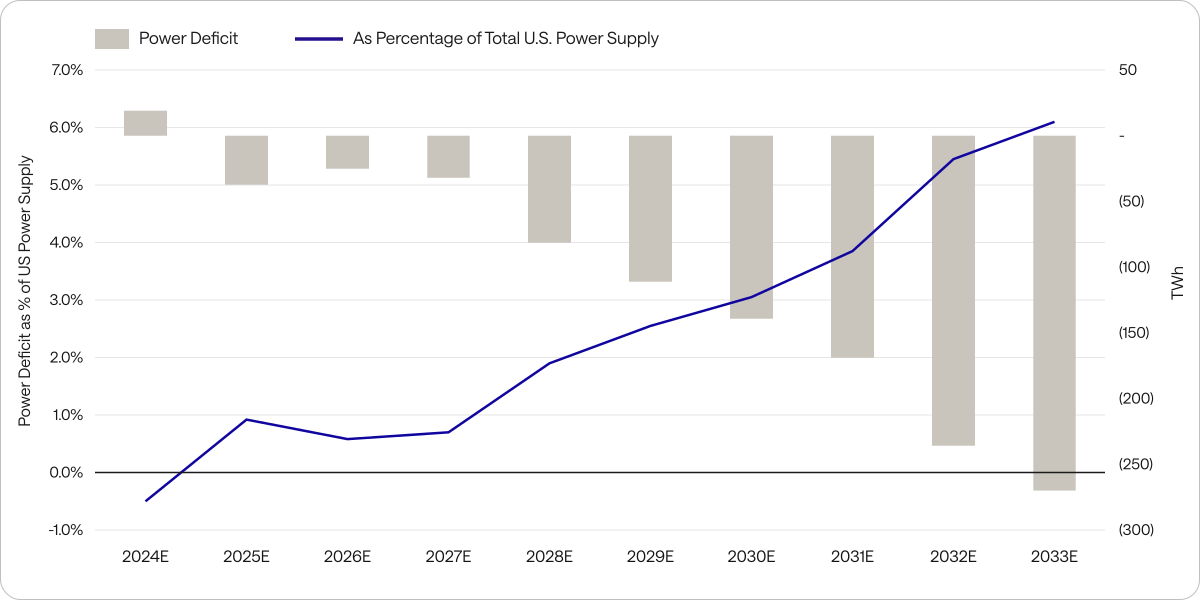
After two decades of near stagnation, electricity demand is reaccelerating as the economy becomes more power intensive. Over roughly the past 15 years, U.S. power demand was largely flat, leaving many utilities focused more on renewable integration than broad capacity expansion.1 That backdrop is changing quickly.
Artificial intelligence infrastructure is increasing data center load. Global data center electricity demand is expected to more than double from about 415 terawatt-hours in 2024 to about 945 terawatt-hours by 2030.2 In the United States, AI could require up to 90 gigawatts of incremental power production capacity over the next five years.3 Electrification is expanding the role of electricity across transportation, buildings, and industry. Advanced manufacturing and industrial policy are pushing more energy-intensive manufacturing and production back into strategic domestic markets. Together, these forces are driving a new inflection in power demand and increasing the importance of power generation, transmission infrastructure, and grid reliability across the global economy.
Power Deficit as a Percentage of Forecasted U.S. Power Supply
We believe select businesses helping to generate, move, and deliver electricity more reliably may be positioned to create long-term value for our clients as power becomes more central to economic growth.
Strategy Starts With the Bottlenecks
From an investment strategy perspective, AI is putting significant strain not only on AI labs and hyperscalers, but also on the surrounding infrastructure and ecosystem. By identifying key pressure points within that ecosystem, including generation, transmission and distribution, and engineering, procurement, and construction, we can uncover quality investment ideas in areas where the ability to rapidly add capacity is limited.
Transmission Is the Backbone of the Buildout
One area where the strain is becoming visible is within power transmission and distribution. Power generation is only part of the challenge. Getting the power to where it needs to go is often far more difficult, requiring miles of contiguous infrastructure and specialized labor to develop and build. The strain from additional generation and load growth is also driving demand for new infrastructure, upgrades, and refurbishment of older infrastructure, further tightening labor availability.
Quanta Services fits naturally into this part of the story. Quanta may not be the first company investors associate with artificial intelligence, but it is a critical enabler of the broader buildout. It brings together engineering capability, project management, and a large base of skilled labor that takes years to train and is difficult to replicate. Quanta has an employee base of about 70,000 skilled craft workers who help build and maintain power infrastructure across the United States.4 The company also ended 2025 with a record backlog of $44.0 billion, reflecting accelerating demand in its electric segment and sustained activity across its end markets.5 In a market where transmission expansion is becoming more urgent, those capabilities should become increasingly valuable.
Transformer Scarcity Is Becoming Its Own Opportunity
If transmission is the backbone of the buildout, transformers are one of its most important bottlenecks.
Hyosung Heavy Industries plays into this part of the story. Its heavy industries segment manufactures large power transformers, gas-insulated switchgear, and other grid equipment, generating the overwhelming share of the company’s operating profit. Our thesis rests on the view that grid equipment demand is being driven by three forces at once, aging-grid replacement, net-new load from artificial intelligence and electrification, and the need for long-haul transmission to connect generation with demand centers.
Lead times for large power transformers have extended sharply, and supply appears likely to remain constrained even if announced capacity expansions are completed on schedule. Large substation and generator step-up transformers have lead times of roughly 80 to 210 weeks, reflecting a market where demand continues to exceed available supply.6 Skilled labor is limited, key materials remain bottlenecked, and manufacturers appear more disciplined about adding capacity after the last cycle’s overbuild.
Hyosung appears particularly relevant because it sits at the highest-value part of the transmission buildout. The growing importance of 765-kilovolt transformers reflects the need to move larger volumes of electricity over long distances with lower losses and greater efficiency. Its Memphis facility gives the company a meaningful domestic position in a market where utility procurement is highly reference driven and where delivery risk matters.
The margin story may be just as important as the demand story. Heavy industries margins have already improved, but more may still be ahead, with the case resting on a geographic mix shift toward the United States, a product mix shift toward higher-voltage transformers, and continued price inflation in a supplier-dictated market.6
Grid Access Is Creating a Market for On-Site Power
Another bottleneck is grid access. Even where utilities have available power, connecting a large data center can require utility studies, regulatory approvals, transmission upgrades, and long-lead-time equipment. Data centers are expected to account for about 55 percent of projected U.S. electricity demand growth over the next five years, which helps explain why grid access is becoming a constraint.7 These grid-connection bottlenecks can delay projects and create demand for on-site generation.
Siemens Energy is especially relevant here. Its gas turbines are increasingly used in data center applications where customers require large amounts of consistent power within a deliverable timeframe ahead of what can be provided by their local utility. Data centers were historically too small to justify these kinds of investments, but the scale of AI-related data centers is making these behind-the-meter deployments more feasible and even necessary in some cases. Data centers have grown from a negligible share of Siemens Energy’s turbine business several years ago to more than 20 percent of the turbine order book today.8
Gas turbines are well suited for this case. They are proven, compact, efficient, and can deliver hundreds of megawatts of power, which is the scale often required by these new data centers. Siemens Energy’s SGT5-9000HL gas turbine can deliver power at the scale increasingly required by large AI data centers.9 If power demand continues to rise faster than grid capacity can expand, dispatchable generation becomes more valuable, particularly in locations where time to power is critical.
Speed To Power Is Becoming a Competitive Advantage
A fourth business in this story is Bloom Energy. Bloom fits the same broad theme of grid constraint and on-site power, but it does so through a different technology and risk profile. Its fuel cell systems are modular and designed to provide always-on power in applications where speed to deployment matters.
Alternative on-site solutions can become more attractive when grid access is delayed, and turbine availability is constrained. Bloom’s systems are being used as baseload power for data centers, not just as backup. Customers are looking for primary power that can be brought online faster than traditional infrastructure allows.
Bloom is more technology-driven than Quanta, Hyosung, and Siemens Energy, and the range of outcomes is wider. The key issue is whether modularity, deployment speed, and reliable on-site power become more valuable as artificial intelligence infrastructure scales.
The Opportunity Set Is Broader Than It Looks
Taken together, these businesses help show why opportunities in the provision and transmission of power for AI are often broader than many investors assume. Quanta Services represents the labor and execution backbone behind the buildout. Hyosung Heavy Industries represents the transformer bottleneck inside the transmission system. Siemens Energy represents both dispatchable generation and grid modernization at global scale. Bloom Energy represents a faster, more modular approach to on-site power.
Each addresses a different bottleneck. Each benefits from the same broad reality, electricity is becoming a more important constraint on digital growth, industrial expansion, and economic resilience.
This Is Not Style Drift
While power equipment and engineering, procurement, and construction have traditionally not been areas where Sands Capital Management has invested in developed markets, the structural shift in power demand has allowed select companies to leverage their existing market positions and capture a larger share of industry economics.
Selection remains critical. Many companies provide different products and services into the ecosystem. Consistent with our investment criteria, we focused on what we believe are the companies with the largest growth opportunity, the most innovative and leading products and services, and the most well-entrenched business models within their areas. In our view, this should allow these companies to capitalize to a greater extent on this underlying secular shift.
The Physical Layer of Growth May Be Underappreciated
The larger takeaway is straightforward. Power is the critical input to AI, electrification, and industrialization. We believe it will be a prime determinant and governor of the growth and future of these industries.
That makes the electrical system more important than it has been in decades. It also broadens the investment lens. The next phase of growth will not be enabled only by better models or faster chips. It will also depend on the businesses building the physical systems underneath them.
Those businesses may not always be the most obvious beneficiaries of change, but they may prove to be some of the most important.
1. U.S. Energy Information Administration, electricity demand data and related analysis. Used to support the characterization of largely flat U.S. power demand over roughly the past 15 years.
2. International Energy Agency, “Energy and AI,” April 2025.
3. Grid Strategies, “Power Demand Forecasts Revised Up Again in 2025,” 2025, https://gridstrategiesllc.com/wp-content/uploads/Grid-Strategies-National-Load-Growth-Report-2025.pdf
4. Grid Strategies, “Power Demand Forecasts Revised Up Again in 2025,” 2025.
5. Quanta Services, “Quanta Services Reports Fourth Quarter and Full-Year 2025 Results,” February 19, 2026.
6. Wood Mackenzie, “Supply shortages and an inflexible market give rise to high power transformer lead times,” 2024. Wood Mackenzie states that large substation power and generator step-up transformers have lead times ranging from 80 to 210 weeks. This figure is also cited in CISA’s June 2024 transformer shortage report.
7. Grid Strategies, “Power Demand Forecasts Revised Up Again in 2025,” 2025. The report states that data centers account for about 55 percent of demand growth in utility load forecasts over the next five years.
8. Siemens Energy, “Earnings Release Q1 FY 2026,” February 11, 2026; Siemens Energy, “Earnings Release Q2 FY 2026,” May 12, 2026.
9. Siemens Energy, “SGT5-9000HL heavy duty gas turbine for 50Hz power generation,” Siemens Energy, as of June 10, 2026, https://www.siemens-energy.com/global/en/home/products-services/product/sgt5-9000hl.html.
Disclosures:
The views expressed are the opinion of Sands Capital and are not intended as a forecast, a guarantee of future results, investment recommendations or an offer to buy or sell any securities. The views expressed were current as of the date indicated and are subject to change.
This material may contain forward-looking statements, which are subject to uncertainty and contingencies outside of Sands Capital’s control. No reliance should be placed on these forward-looking statements. There is no guarantee that owning securities of companies meeting Sands Capital’s criteria will cause outperformance compared to a benchmark or index.
All investments are subject to market risk, including the possible loss of principal. Recent tariff announcements may add to this risk, creating additional economic uncertainty and potentially affecting the value of certain investments. Tariffs can impact various sectors differently, leading to changes in market dynamics and investment performance. There is no guarantee that Sands Capital will meet its stated goals. Past performance is not indicative of future results. A company’s fundamentals or earnings growth is no guarantee that its share price will increase.
As of June 18, 2026, Quanta Services, Hyosung Heavy Industries, Siemens Energy and Bloom Energy were held across Sands Capital strategies. The companies identified represent a subset of current holdings and were selected by the author on an objective basis to illustrate the views expressed in the commentary.
Any holdings outside of the portfolio that were mentioned are for illustrative purposes only.
The specific securities identified and described do not represent all of the securities purchased, sold, or recommended for advisory clients. There is no assurance that any securities discussed will remain in the portfolio or that securities sold have not been repurchased. You should not assume that any investment is or will be profitable.
References to the “firm”, “we” or “our” are references to Sands Capital. Sands Capital refers to the combination of Sands Capital Management, LLC, Sands Capital Alternatives, LLC and Sands Capital Horizons, LLC. All three firms are registered investment advisers with the United States Securities and Exchange Commission in accordance with the Investment Advisers Act of 1940. The three registered investment advisers share certain personnel, office space, and other resources.
This communication is for informational purposes only and does not constitute an offer, invitation, or recommendation to buy, sell, subscribe for, or issue any securities. The material is based on information that we consider correct, and any estimates, opinions, conclusions, or recommendations contained in this communication are reasonably held or made at the time of compilation. However, no warranty is made as to the accuracy or reliability of any estimates, opinions, conclusions, or recommendations. It should not be construed as investment, legal, or tax advice and may not be reproduced or distributed to any person.